International succession concerns many families today, particularly where the deceased owned assets in several countries or lived abroad. In such situations, it is essential to understand which applicable law governs the estate, what inheritance taxes apply, and how to avoid issues related to double taxation.
Between law, legal rules, taxation, and European regulations, international succession is governed by specific principles that must be clearly understood in order to protect heirs and properly organise the transfer of assets.
Understanding the Rules of International Succession
An international succession arises whenever an element of the estate crosses the borders of a single state. This may be the deceased’s habitual residence, nationality, domicile, or the presence of assets located in another country.
Since the entry into force of the EU Succession Regulation in August 2015, the main rule is relatively clear: the applicable law governing the estate is the law of the country of the deceased’s habitual residence at the time of death. This principle applies throughout the European Union, with the exception of Ireland and Denmark, which maintain their own succession rules.

However, this system allows a degree of flexibility. A person may choose, in a will, the law of their nationality to govern their estate. This choice of law is fundamental, as it determines how assets will be distributed among heirs.
For example, a French national living abroad may opt for French law in order to preserve civil law principles, particularly forced heirship rules (réserve héréditaire).
The Role of the EU Regulation and Applicable Rules
The EU Regulation on international succession has significantly simplified matters. Before its application, a single estate could be governed by multiple legal systems, depending on the location of movable or immovable assets.
Today, the Regulation establishes a single applicable law for the entire estate, ensuring clarity in administration and preventing conflicts between different legal systems.
This mechanism is primarily based on the concept of habitual residence, which serves as the central criterion for determining the applicable law. However, in certain complex situations, a detailed legal analysis is still required, particularly where strong connections exist with several countries.
Taxation of International Succession
Taxation is often the most sensitive aspect of international succession. Unlike the applicable law, which is generally unified, tax liability may depend on multiple criteria.
In France, inheritance tax may apply even if the deceased was resident abroad, particularly where heirs are tax resident in France or where assets located in France form part of the estate.
This means that a single international estate may fall under several tax systems. In such cases, the risk of double taxation is real, as two or more states may claim taxing rights over the same assets.
To limit this risk, France has entered into international tax treaties with several countries. Each treaty determines which state has taxing rights over specific assets and how taxation is allocated between jurisdictions.
It is therefore essential to consider taxation early when planning an international succession in order to optimise the transfer of wealth and avoid excessive tax burdens for heirs.
Effective Planning of an International Succession
Planning an international succession is now essential for anyone with links to more than one country. This planning begins with a clear understanding of the applicable law and a carefully considered choice of law.
A will plays a central role. It not only allows the appointment of heirs but also enables the testator to designate the applicable law and organise the distribution of both movable and immovable assets. In the absence of a will, default legal rules apply, which may lead to unintended consequences.
It is also advisable to take into account habitual residence, tax residence, nationality, and place of death, as these factors influence how the estate will be administered.
In this context, consulting a notaire or an international succession specialist is often essential. This professional can assess the legal and tax situation and propose tailored solutions to secure the transfer of assets.
The Usefulness of Certificates and International Instruments
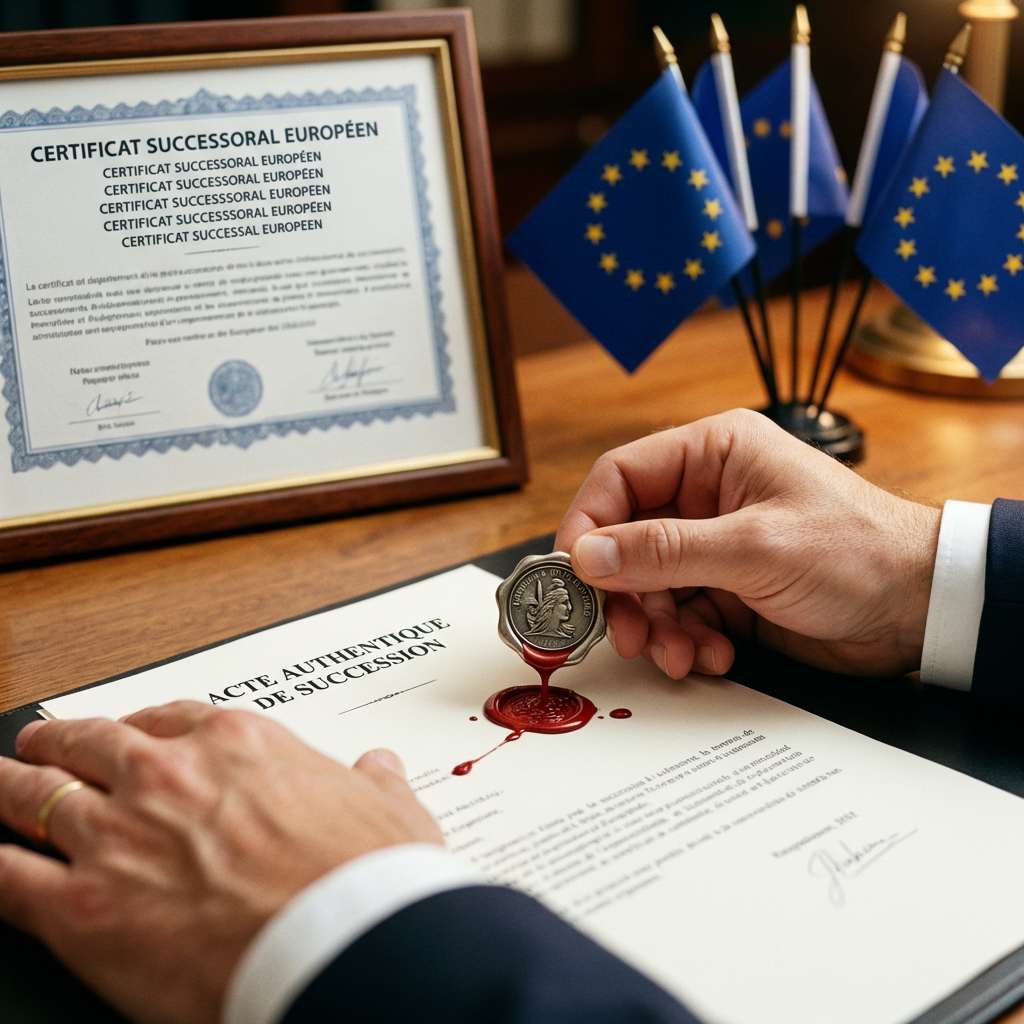
Within international succession, certain tools significantly simplify procedures. The European Certificate of Succession is one of the most important. It allows heirs to prove their status in another Member State and gain easier access to assets located abroad.
This certificate is recognised throughout the European Union, greatly simplifying administrative formalities and avoiding the need for separate proceedings in each country involved.
In addition, international tax treaties play a key role, particularly in taxation. These agreements coordinate rules between states in order to prevent conflicts and reduce double taxation. Without such treaties, the administration of international estates would be significantly more complex.
Which Assets Are Covered by International Succession?
An international succession may involve different types of assets, including immovable property such as houses or apartments, as well as movable assets such as bank accounts and financial investments.
The location of assets is particularly important for tax purposes, as each country may claim taxing rights over assets situated within its territory. For example, assets located in France may be subject to French inheritance tax even if the deceased was resident abroad.
International succession is therefore based on a balance between legal rules, applicable law, taxation, and coordination between multiple jurisdictions. Thanks to the EU Regulation, the framework has been simplified, but complexity remains, particularly in relation to taxation and cross-border asset management.
In all cases, proper planning helps avoid difficulties, protect heirs, and ensure that the estate is administered in accordance with the deceased’s wishes.